
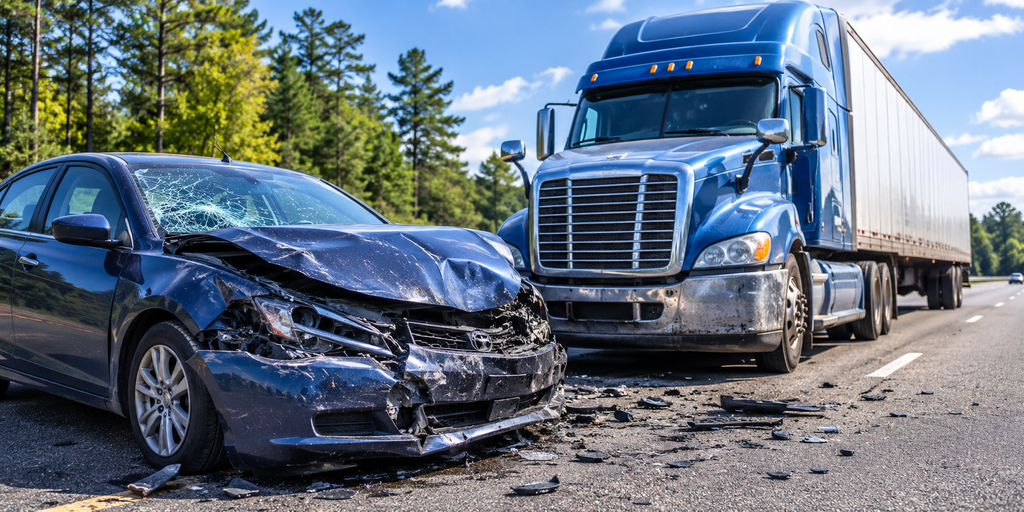
A South Carolina truck accident can leave victims with serious injuries, expensive medical bills, lost income, and a long road to recovery. When an 18-wheeler, tractor-trailer, or other commercial crashes into a passenger vehicle, the people in the smaller vehicle almost always suffer the most and sometimes are killed. These wrecks can happen on busy interstates, rural highways, local roads, and even in residential areas.
Truck accidents are different from ordinary car accidents. Commercial trucks are much larger and heavier than passenger vehicles. They also operate under special federal and state safety rules. When a truck driver, trucking company, or another responsible party fails to follow those rules, the results can be devastating.
If you or someone you love has been injured in a South Carolina truck accident, understanding what caused the crash and who may be responsible is an important first step. Knowing what to do after a collision can also help protect your health and your legal rights.
Large trucks play an important role in moving goods throughout South Carolina and the rest of the country. However, the size and weight of these vehicles can make collisions especially dangerous.
According to the National Highway Traffic Safety Administration (NHTSA) latest estimates, over 5,000 people die in crashes involving large trucks per year. Approximately 161,000 more people were seriously injured in these crashes.
Latest estimates for truck crashes that took place in South Carolina: 145 fatalities plus 1,890 more serious injuries (Federal Motor Carrier Safety Administration).
These numbers show why truck safety remains an important concern for drivers and families.
South Carolina has major transportation routes used by commercial trucks every day. These include:
Heavy truck traffic, highway construction, changing weather, and congested roads can create dangerous driving conditions.
A serious South Carolina truck accident can happen almost anywhere, and the consequences can affect an entire family for years.
Truck crashes do not always happen just because of one mistake. Sometimes several problems contribute to a collision. An investigation may reveal that the driver, trucking company, vehicle maintenance provider, or another party all had a hand in causing the accident.
Some of the most common causes include:
Truck drivers often spend long hours traveling across state lines. When drivers do not get enough rest, they may have trouble concentrating, reacting to traffic, and making safe decisions.
Fatigue can slow reaction times and increase the risk of serious mistakes. A tired driver may drift into another lane, fail to notice stopped traffic, or misjudge the distance needed to stop.
Federal hours-of-service rules limit how long many commercial truck drivers can operate their vehicles. For property-carrying drivers, the general rules include:
These rules are designed to reduce fatigue-related crashes. However, violations can still happen.
Large trucks need more room to stop than passenger vehicles. When a truck driver travels too fast or follows another vehicle too closely, there may not be enough time to avoid a collision.
Speeding can be especially dangerous in heavy traffic, construction zones, bad weather, and areas with sharp curves or steep grades.
Truck drivers must pay attention to the road, surrounding traffic, and changing conditions.
Accident Causing Distractions can include:
Even a few seconds of inattention can cause a driver to hit a stopped vehicle or drift into another lane.
Commercial trucks must be inspected and maintained to remain safe on the road.
Problems with brakes, tires, steering systems, lights, and other important parts can cause a driver to lose control or make it impossible to stop in time.
Trucking companies may be responsible when they fail to maintain their vehicles or allow unsafe trucks to continue operating.
A truck carrying an improperly balanced or unsecured load can become dangerous.
Cargo that shifts during a trip may cause the truck to tip, roll over, or become difficult to control. Loose cargo can also fall onto the road and create hazards for other drivers.
Federal regulations require commercial truck cargo to be properly distributed and secured.
Large commercial trucks have blind spots along their sides, behind their trailers, and directly in front of the cab.
Truck drivers must use extra care when changing lanes, turning, backing up, and merging into traffic.
A careless lane change can force another driver off the road or cause a serious sideswipe collision.
Alcohol, illegal drugs, and certain medications can affect a truck driver’s judgment and reaction time.
Commercial drivers are held to strict alcohol and drug testing requirements. A driver who operates a commercial vehicle while impaired can put everyone nearby at risk.
Because of their size and weight, commercial trucks can cause devastating injuries in a collision with a passenger vehicle.
Some injuries are immediately apparent, while others may take hours or days to develop. Common truck accident injuries include:
Some victims require emergency surgery, months of rehabilitation, or lifelong medical care.
A serious South Carolina truck accident can also affect a person’s ability to work, care for family members, and enjoy everyday activities.
Medical treatment should always come first. Even if you believe your injuries are minor, get checked by a medical professional. Some serious injuries are not immediately noticeable.
One of the biggest differences between a car accident and a commercial trucking accident is the number of parties who may be responsible.
The truck driver is not always the only person or company that may be legally responsible for a crash.
For more information, read our blog Who Can Be Held Liable in a Truck Accident in SC?
Commercial trucks that operate in interstate commerce are generally subject to regulations established by the Federal Motor Carrier Safety Administration (FMCSA).
These regulations are important because they establish safety requirements for drivers and trucking companies.
Some of the rules investigators may examine include:
A violation of a federal safety rule does not automatically establish liability in every case. However, evidence of a violation may be important when determining whether a driver or company acted negligently.
Evidence is especially important in commercial trucking cases. Some information may be controlled by the trucking company or its insurance carrier, rather than the injured person.
Important evidence may include:
Some electronic records may be overwritten, lost, or discarded as time passes. Physical evidence may also disappear when vehicles are repaired or returned to service.
For this reason, preserving evidence as early as possible can make a big difference in a truck accident investigation and lawsuit.
If you are involved in a collision with a commercial truck, your first priority should be your safety and medical care.
Here are some important steps to take.
Report the accident and request emergency medical assistance if anyone is injured. A police report can provide important information about the collision.
South Carolina law requires drivers involved in crashes resulting in injury or death to immediately notify the appropriate law enforcement agency.
Accept medical assistance at the scene if needed. Even if you feel okay, seek medical attention as soon as possible.
Follow your doctor’s recommendations and keep records of your treatment, medications, and appointments.
If you are physically able, collect information from the truck driver, including:
Also obtain contact information from witnesses and other drivers involved in the crash.
Photograph and video ( if possible ) the vehicles, road conditions, traffic signs, skid marks, debris, visible injuries, and the surrounding area.
In addition, take pictures of the truck’s company name and identification numbers, but don’t put yourself in danger to collect evidence.
Save medical bills, prescription receipts, repair estimates, insurance correspondence, and documentation of missed work.
Keep a simple record of how your injuries affect your daily activities.
You may receive calls from the trucking company’s insurance adjuster shortly after the crash.
Be careful about giving recorded statements, accepting a quick settlement, or signing documents before understanding your rights.
An early settlement may not account for future medical treatment, lost earning capacity, disability or other permanent injuries.
A lawyer can investigate the collision, identify potentially responsible parties, request important evidence, and communicate with insurance companies.
Getting legal guidance early can help protect evidence before it disappears.
South Carolina generally has a three-year statute of limitations for personal injury claims based on negligence.
Under South Carolina Code Section 15-3-530(5), many personal injury lawsuits must be filed within three years after the injured person knew or reasonably should have known that they had a claim.
Wrongful death lawsuits generally must also be filed within three years from the date of death under Section 15-3-530(6).
However, certain exceptions may apply. Claims involving government entities, minors, or other special circumstances may have different requirements or deadlines, some may be as short as two years.
Do not assume you have plenty of time. Waiting too long can make it harder to locate witnesses, obtain records, and preserve important evidence.
Yes. South Carolina follows a modified comparative negligence rule.
Under this rule, an injured person may generally recover damages as long as their negligence is not greater than the combined negligence of the defendant or defendants.
For example, if a jury finds that you were 20% responsible for a crash and your total damages are $100,000, your recoverable damages would generally be reduced by 20%, leaving you $80,000.
However, if your percentage of fault is greater than the combined fault of the defendant or defendants, you generally cannot recover under this rule.
Insurance companies sometimes try to place more blame on injured drivers to reduce the amount they must pay. A thorough investigation can help establish what actually happened.
A serious truck accident can create financial and personal losses that continue long after the crash.
Depending on the facts of the case, an injured person may be able to seek compensation for:
Also, in cases involving a fatal truck accident, surviving family members may have a wrongful death claim under South Carolina law.
The amount of compensation depends on the injuries, available evidence, financial losses, and legal circumstances of the case. Unfortunately, no recovery is guaranteed, so it’s key to get all the facts about what happened.
Trucking companies and their insurance carriers often begin investigating a serious crash immediately. They may have access to investigators, safety professionals, and legal teams.
An injured person should not have to face that process alone.
A thorough truck accident investigation may involve reviewing electronic records, examining the vehicles, interviewing witnesses, reconstructing the crash, and investigating the driver’s history and the trucking company’s safety practices.
It may also require sending preservation requests to prevent important evidence from being destroyed or lost.
The goal is to thoroughly understand exactly how the collision happened and identify everyone who may be legally responsible.
If you or someone you love has been injured in a South Carolina truck accident, you deserve to have your questions answered and your legal options explained.
The Law Offices of David L. Hood has represented injured people throughout South Carolina since 1991. Our firm understands that a serious trucking collision can change a person’s life in an instant. Medical bills, lost income, pain, and uncertainty can create enormous stress for an entire family.
Attorney David L. Hood and his legal co-counsel team work with qualified professionals when needed to investigate serious injury cases, examine the evidence, and pursue claims against responsible parties.
The Law Offices of David L. Hood has received recognition from several legal organizations, including:
We have also been recognized by BusinessRate among personal injury attorneys.
The firm has earned over 109 five-star client reviews, reflecting the experiences of people who have trusted us with their legal matters.
If you have been injured in a commercial truck collision, do not wait to find out what your options may be. Contact The Law Offices of David L. Hood for a free, no-obligation initial consultation. The firm handles qualifying injury cases on a contingency-fee basis, meaning attorney fees are not owed unless a recovery is obtained, subject to the terms of the representation agreement.
Contact us at one of our 18 South Carolina locations, or by chat, text or email today for a free, no-obligation consultation!
In most cases, South Carolina allows three years to file a personal injury lawsuit. Wrongful death claims generally have a three-year deadline as well. If you’re suing a government entity, it’s typically two years. Certain exceptions may also apply, so it is important to speak with an attorney as soon as possible.
Yes. A trucking company may be legally responsible if its’ negligence contributed to the collision. Examples include negligent hiring, inadequate driver training, unsafe scheduling, failure to maintain trucks, and failure to follow applicable safety regulations.
The trucking company may be responsible for the driver’s actions under certain circumstances. The company may also have separate liability if its own negligence contributed to the crash.
Important evidence may include electronic logging device records, GPS information, truck inspection records, maintenance documents, driver qualification records, accident reports, photographs, witness statements, and medical records.
Yes. South Carolina follows comparative negligence rules. You may generally recover compensation if your share of fault is not greater than the combined fault of the defendant or defendants. Your recovery may be reduced by your percentage of responsibility.
Be careful about providing recorded statements or accepting a settlement before understanding the full extent of your injuries and losses. You may wish to speak with an attorney before talking to an adjuster, signing documents or agreeing to a settlement.
Eligible family members or a personal representative may be able to pursue a wrongful death claim. Compensation may include certain financial losses and other damages allowed by South Carolina law.
Many personal injury lawyers, including The Law Offices of David L. Hood, handle truck accident claims on a contingency-fee basis. This generally means the attorney receives a fee only if a recovery is obtained.
You probably still have a claim under South Carolina law if the collision occurred in South Carolina. Interstate trucking companies and drivers must also follow applicable federal safety regulations.
It’s smart to seek legal guidance as soon as reasonably possible. Important evidence, including electronic truck data and maintenance records, may not be available indefinitely. Early investigation can help protect your potential claim.